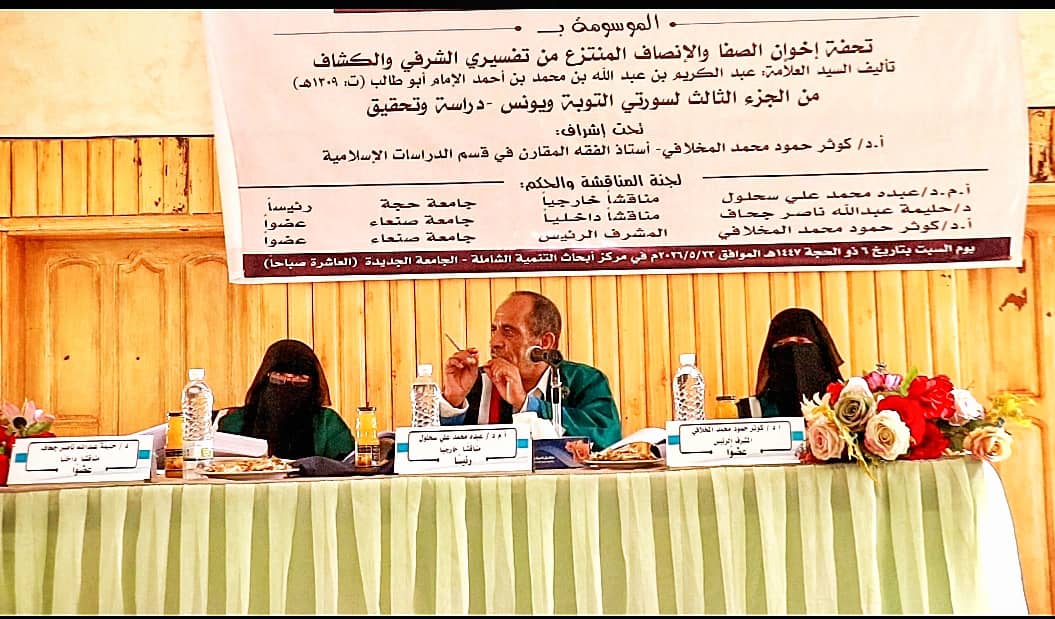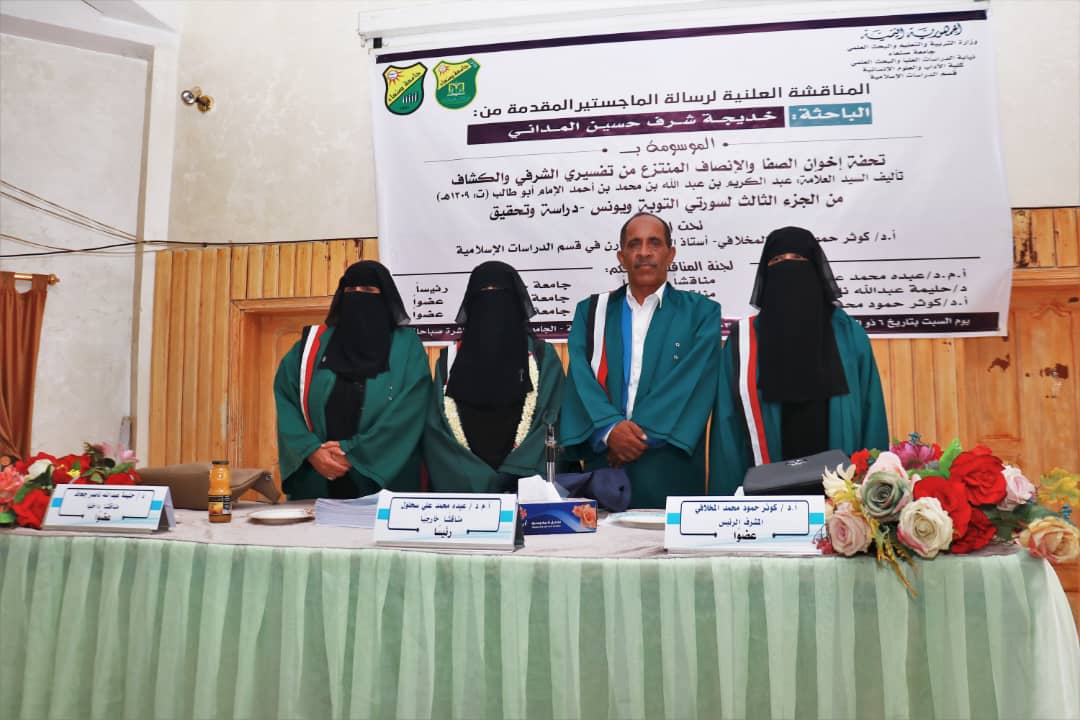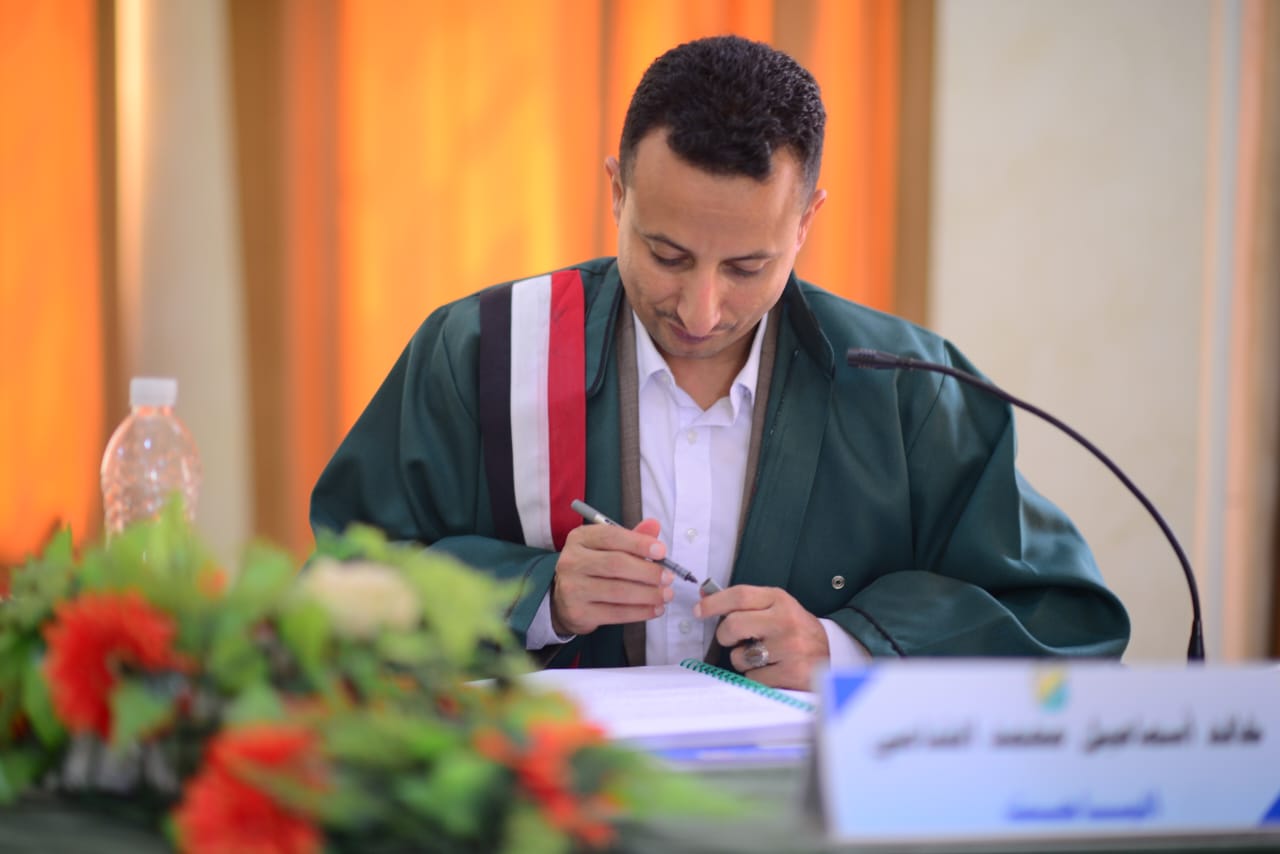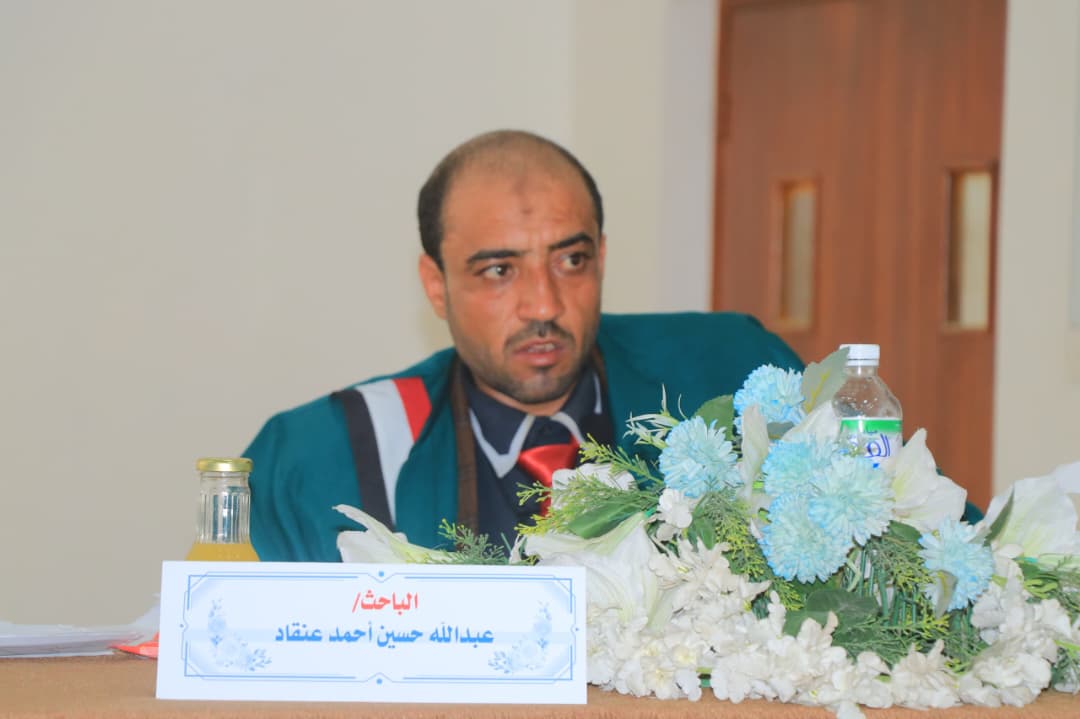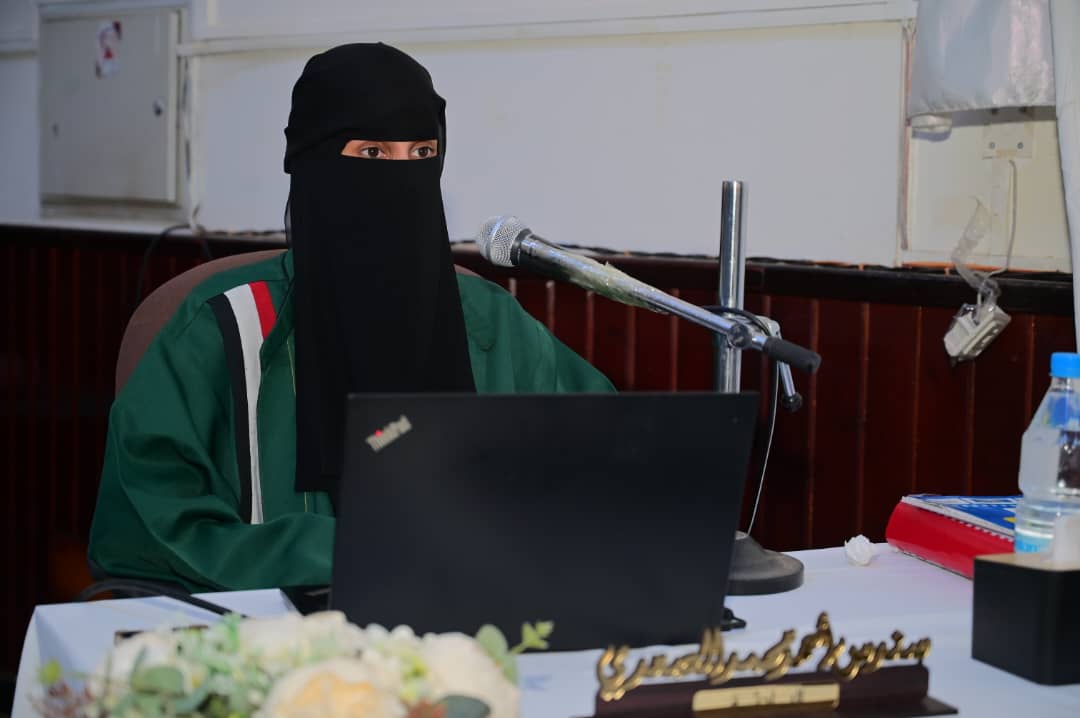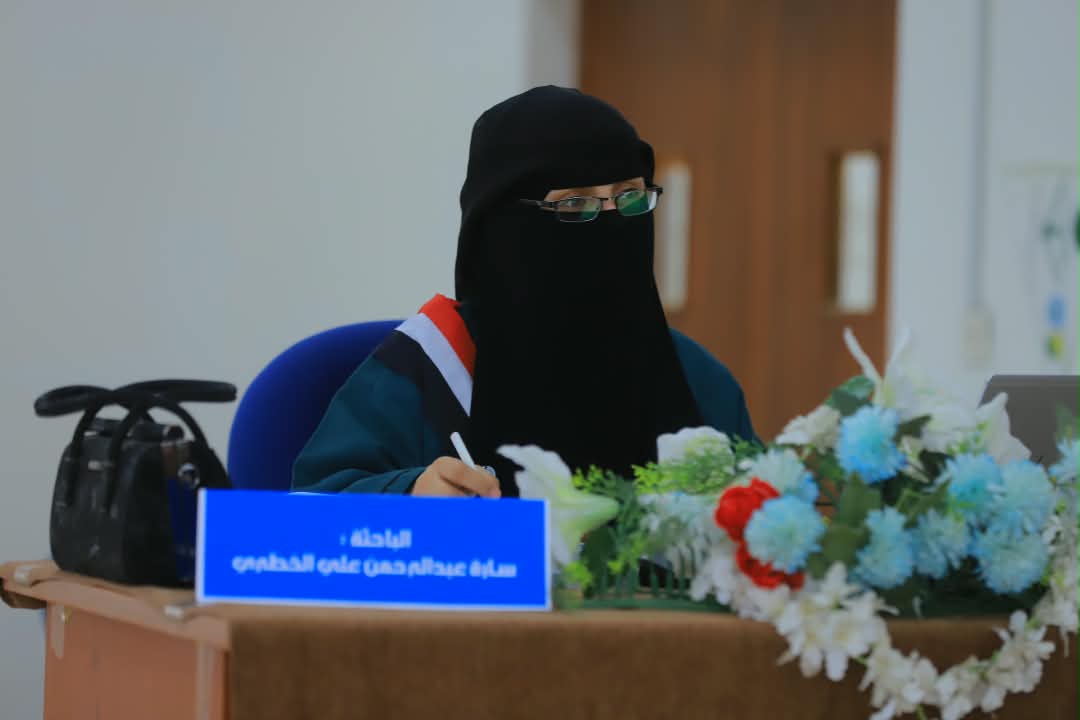
Researcher Khadija Sharaf Hussein Al-Madani was awarded a Master’s Degree in Tafsir and Qur’anic Sciences with an average of excellent and a grade of (95%) for her thesis titled: Tuhfat Ikhwan Al-Safa wa Al-Insaf Al-Muntaza min Tafsir Al-Sharafi and Al-Kashshaf,” authored by the eminent scholar Sayyid Abdulkarim ibn Abdullah ibn Mohammed ibn Ahmed Al-Imam Abu Talib (d. 1309 AH), covering Part Three of the Qur’anic chapters of Al-Tawbah and Yunus: A Study and Critical Investigation, which was submitted to the Department of Islamic Studies, Faculty of Arts– Sana’a University. The MA defense was held on Saturday, May 23, 2026
The MA Viva-voce Committee, which was formed based on a resolution issued by the Graduate Studies and Scientific Research Council, consisted of the following:
• Prof. Kawthar Hamoud Mohammed Al-Mekhlafi – Sana’a University – Principal Supervisor and Committee Member.
• Assoc. Prof. Abdu Mohammed Ali Sahlool – Hajjah University – External Examiner and Committee Chair.
• Dr. Halima Abdullah Nasser Jahaf – Sana’a University – Internal Examiner and Committee Member.
The study aimed to serve, revive, and critically edit Yemeni and Islamic heritage in accordance with scholarly methodology by studying and critically editing the third part of the manuscript “Tuhfat Ikhwan Al-Safa wa Al-Insaf” by Imam Abu Talib (d. 1309 AH), which deals with the Qur’anic chapters of Al-Tawbah and Yunus.
The study also introduced the author, Abu Talib Al-Rawdi, his historical period, and his sources, and examined his methodology in combining the two exegeses “Al-Kashshaf” and “Al-Masabih.” It further focused on documenting the text, explaining obscure terms, tracing and documenting its hadiths and transmitted reports, and attributing his statements and poetry to their respective authors.
The study produced several findings, most notably that the political and economic conditions during the author’s lifetime were not completely stable; however, their impact on scholarly life was not significant. It also established that the author had numerous works in Qur’anic exegesis, Hadith, theology, history, and other fields.
The study further revealed the diversity of scholarly sources on which the author relied, most notably Al-Sharafi’s “Al-Masabih,” Al-Zamakhshari’s “Al-Kashshaf,” Al-Daylami’s “Al-Burhan,” Al-Hussein ibn Al-Qasim’s “Gharib Al-Qur’an,” and the Tafsir of Al-Hadi.
The findings indicated that the scholarly environment in which the author was raised contributed to shaping his intellectual life and broadening his knowledge. They also showed that he compiled the views of the Imams of Ahl al-Bayt, Shiite scholars, and certain exegetes whose interpretations agreed with the views of Ahl al-Bayt, subjecting these views to scholarly discussion and weighing them critically.
The study also demonstrated that the author followed the scholarly methodologies commonly employed by critical editors in describing manuscripts and establishing their texts. He was distinguished by a critical sense and an ability to derive insights and reconcile different exegetical views.
The study concluded that the manuscript “Tuhfat Ikhwan Al-Safa wa Al-Insaf” represents an important scholarly addition to the Yemeni Qur’anic and exegetical heritage.
The study recommended encouraging Yemeni researchers, students of Islamic scholarship, and critical editors to focus on valuable Yemeni manuscripts and undertake their critical editing, facilitating procedures for those interested in editing and preserving heritage, and organizing regular practical training courses in this field. It also called for encouraging researchers and critical editors to continue their work despite the difficulties and obstacles they face.
It further recommended treating the critical editing of heritage works as a public interest that serves the broader Muslim community and contributes to highlighting aspects of Islamic civilization and the richness of Yemeni intellectual heritage. It also recommended printing and publishing the thesis so that readers and researchers may benefit from it.
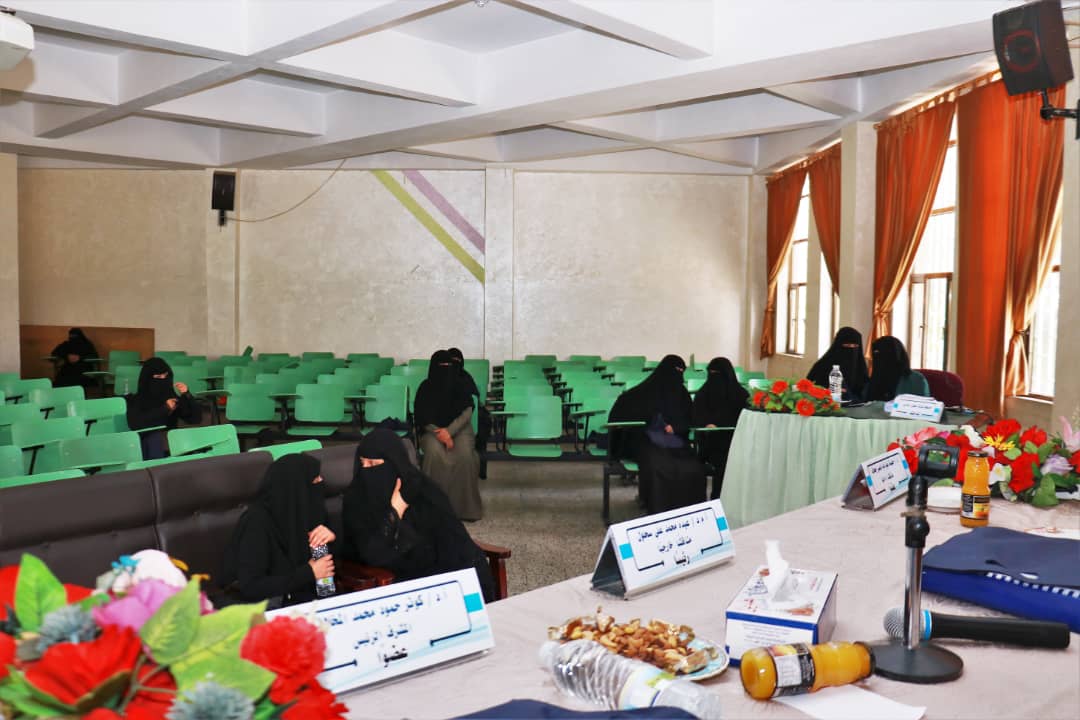
The thesis defense was attended by faculty members, researchers, students, and interested participants as well as the researcher's colleagues and family members..