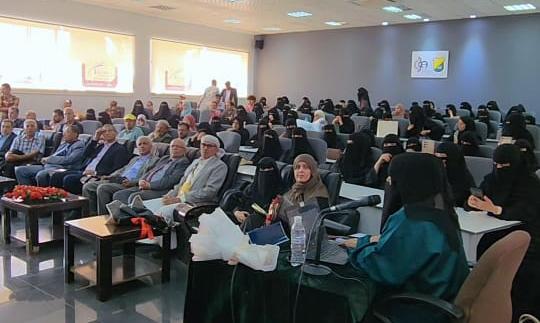
Researcher Balqees Abdulrahman Abdullah Sharaf Al-Deen was awarded a Master’s Degree in Statistics and Information with an average of excellent and a grade of (95%) for her thesis titled: A Statistical Model for Determining the Optimal Retention Limit for Insurance Companies Operating in Yemeni Market: Marine Cargo Insurance, which was submitted to the Faculty of Commerce and Economics– Sana’a University. The MA defense was held on Monday, August 31, 2026.
The MA Viva-voce Committee, which was formed based on a resolution issued by the Graduate Studies and Scientific Research Council, consisted of the following:
• Prof. Abdulkarim Qasim Ahmed Al-Siyaghi – Sana’a University – Internal Examiner and Committee Chair.
• Prof. Abdullah Abdu Mudhesh Ali – Taiz University – External Examiner and Committee Member.
• Assoc. Prof. Mansour Ahmed Yahya Al-Ameri – Sana’a University – Principal Supervisor and Committee Member.
The study aimed to develop an appropriate statistical model that can be used to determine the optimal retention limit for insurance companies operating in the Yemeni market in the marine cargo insurance branch. This was achieved by using the most appropriate probability distributions to model the number of claims and claim amounts, and by employing Chebyshev’s inequality as a predictive tool suited to the Yemeni market environment, which is characterized by limited and irregular data. This approach allows for estimating the minimum probability that losses will exceed specified values (MPY) with a high degree of confidence.
The study also aimed to use Pearson distributions to estimate the annual aggregate loss function for the marine cargo insurance branch at the two companies under study, as well as to utilize certain truncated probability distributions to determine the optimal retention limit.
The findings showed that using appropriate probability distributions, together with a compound probability distribution for the number of claims and claim amounts, contributes to improving the accuracy of estimating potential annual aggregate losses.
The results also demonstrated that Chebyshev’s inequality is the most appropriate predictive tool for the Yemeni market, as it provides suitable estimates of maximum potential losses and can accommodate limited and irregular data without requiring a specific distribution for extreme losses.
The study confirmed that the proposed statistical model demonstrated good efficiency in estimating the optimal retention limit based on actual data from the Yemeni market. It also concluded that the two companies under study follow a relatively conservative retention policy by retaining a percentage below the proposed optimal limit, indicating limited use of actuarial tools in making decisions related to risk retention.
The study recommended that the concerned companies, particularly the Yemeni Islamic Insurance Company and the United Insurance Company, adopt the proposed statistical model as a periodic tool for estimating the retention limit on a quarterly or annual basis, while updating the parameters of the probability distributions based on newly available data.
It also recommended that regulatory authorities require insurance companies to submit an annual or quarterly report outlining the statistical and actuarial bases used to establish their approved retention limits, rather than relying solely on traditional practices.
The study called for similar research to be conducted on other insurance branches in the Yemeni market, such as fire insurance, motor insurance, engineering insurance, and health insurance.
The thesis defense was attended by faculty members, researchers, students, and interested participants as well as the researcher's colleagues and family members.
.