Sana’a – Sana’a University Media Office
Thursday, October 22, 2026, (11 Jumada al-Awwal 1448 AH)
In a research achievement combining environmental sustainability, agricultural waste valorization, and the development of energy storage technologies, three researchers from Sana’a University contributed to an international scientific study published in 2026 in Materials Research Bulletin, a journal published by the international publisher Elsevier. The study examined the development of flexible, sustainable carbon nanofibers for use as electrodes in supercapacitors.
The Sana’a University researchers involved in the study were Dr. Masoud Al-Mujrashaa, Dr. Hisham Abdu Ahmed, and Dr. Amer Ali Mahdi. They worked as part of an international research team comprising researchers from universities and research institutions in China and Yemen.
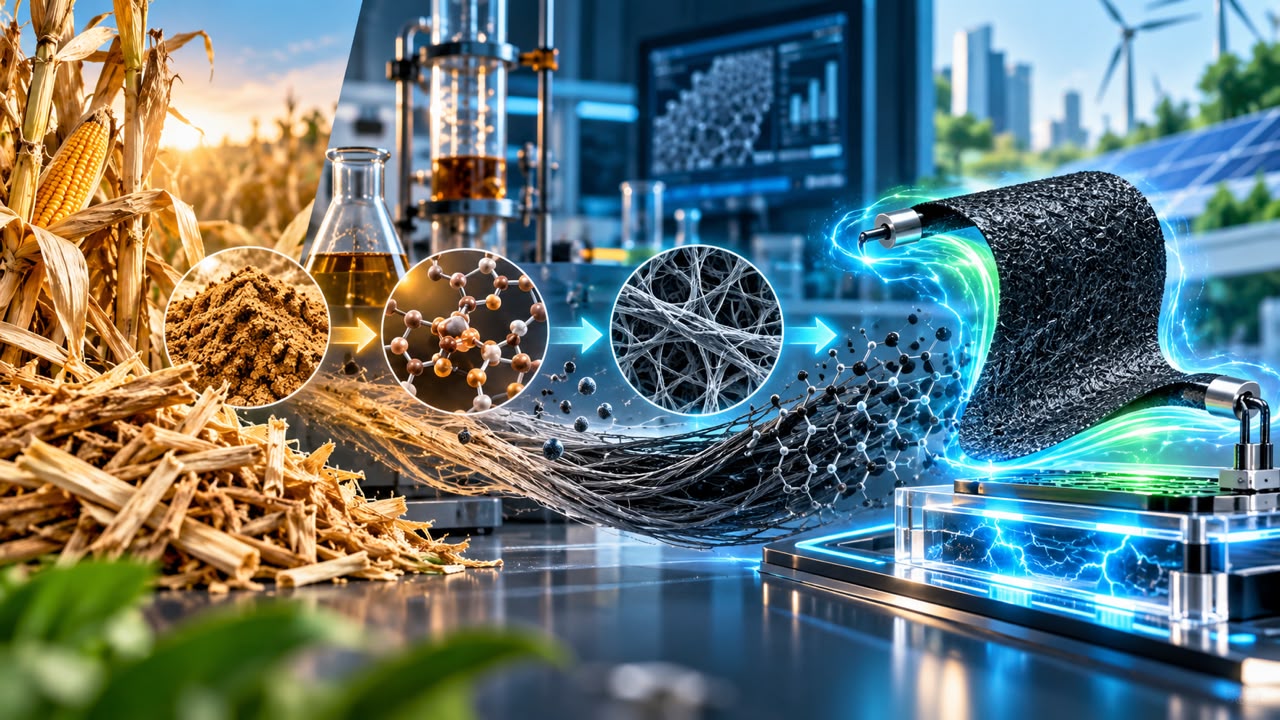
The study used lignin extracted from corn stalks and subjected to enzymatic treatment as a renewable source for producing carbon nanofibers suitable for energy storage technologies. This approach offers a way to transform low-cost agricultural waste into advanced materials with added value.
*An Innovative Strategy for Improving Lignin Properties*
The study explained that one of the main challenges in using lignin to produce carbon fibers is its wide variation in molecular weight, which affects its spinnability and the uniformity of the resulting fibers.
To address this challenge, the researchers developed a strategy combining the fractionation of lignin according to molecular weight with mild chemical modification. The treated lignin was then blended with a polymer, electrospun, and subjected to thermal treatment to produce carbon nanofibers with improved properties.
The results showed a notable improvement in fiber uniformity and performance. The electrode prepared at 800°C, designated CF1–800, delivered the best performance among the samples studied, achieving a specific capacitance of 273 F/g at a current density of 1 A/g.
The electrode also demonstrated notable mechanical flexibility, bending through an angle of up to 180 degrees without breaking. When used in a symmetric supercapacitor, it achieved a specific capacitance of 122.6 F/g and an energy density of approximately 24.5 Wh/kg at a power density of 575.6 W/kg.
*Transforming Agricultural Waste into Advanced Energy Storage Materials*
The significance of the study lies in presenting a scientific approach to utilizing corn stalks, a source of renewable biomass, to produce advanced carbon materials for energy storage applications. It also addresses one of the principal challenges limiting the use of lignin in carbon fiber manufacturing.
The findings demonstrate the potential to combine sustainability, flexibility, and electrochemical performance in materials that may be suitable for modern energy storage technologies. This supports research efforts aimed at developing more efficient and sustainable solutions while making better use of biological resources and agricultural waste.
The study was published in Volume 203 of Materials Research Bulletin in 2026, Article No. 114223, with DOI 10.1016/j.materresbull.2026.114223.
The participation of Sana’a University researchers in this international scientific study reflects the University’s engagement in interdisciplinary research combining materials science, biomass utilization, and energy technology. It also contributes to strengthening international research collaboration and developing scientific solutions to sustainability issues and energy challenges.
For further details, please visit the following link:
https://www.sciencedirect.com/science/article/abs/pii/S0025540826002345?via%3Dihub