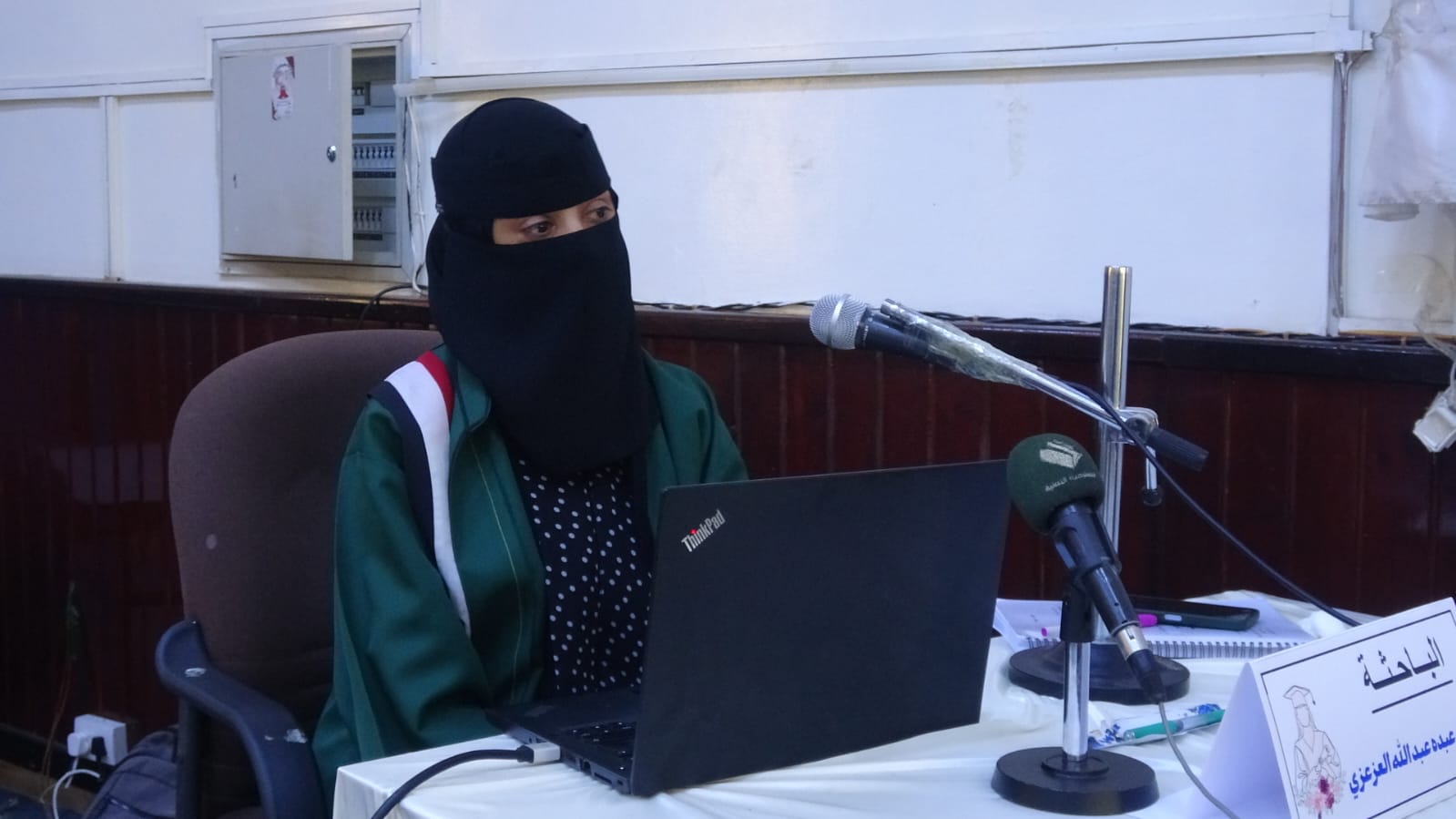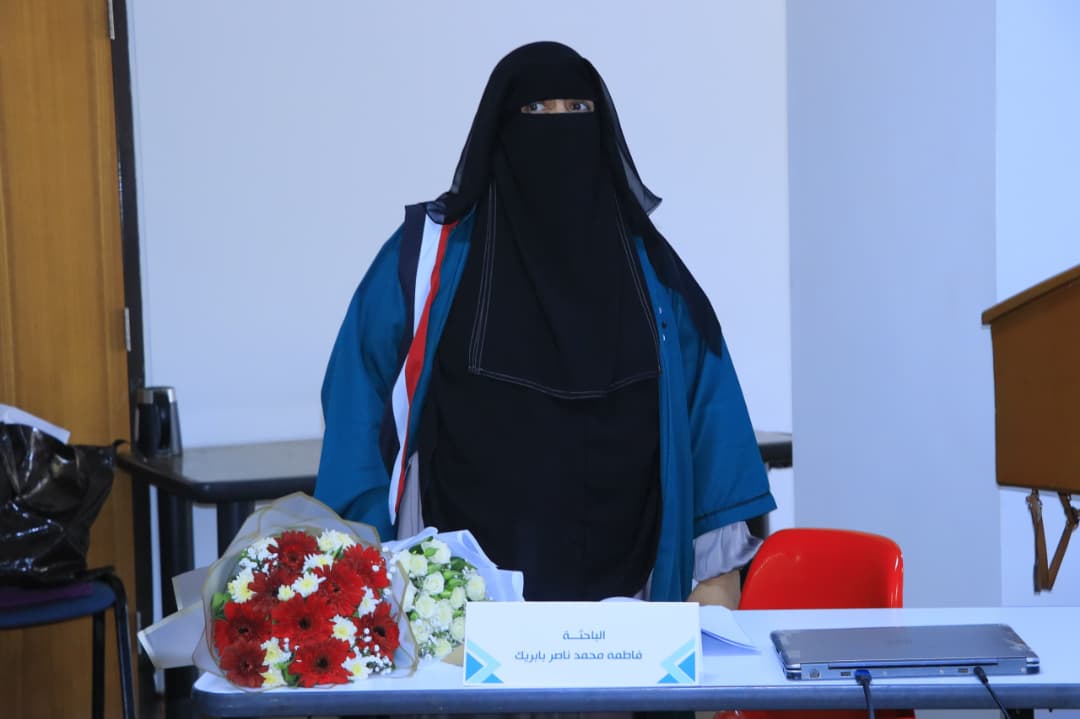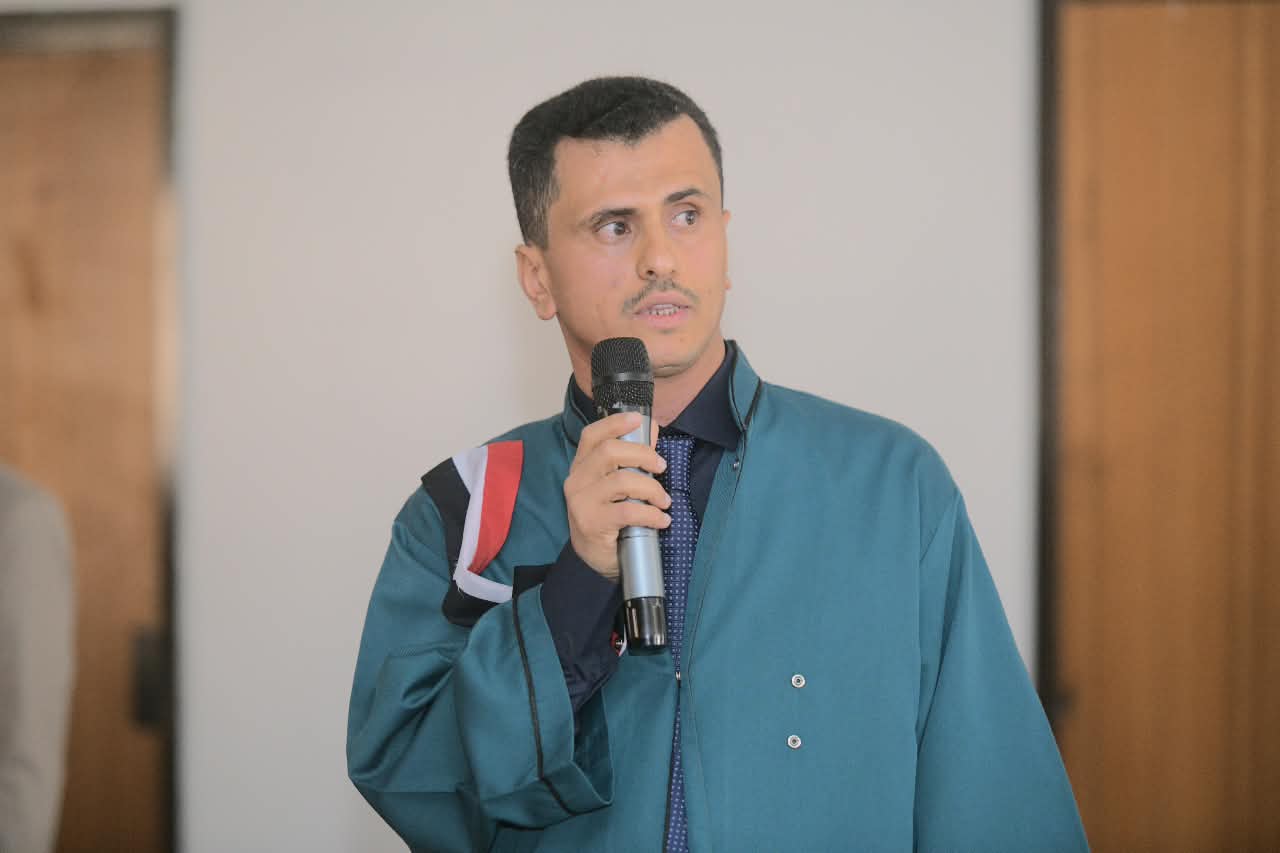
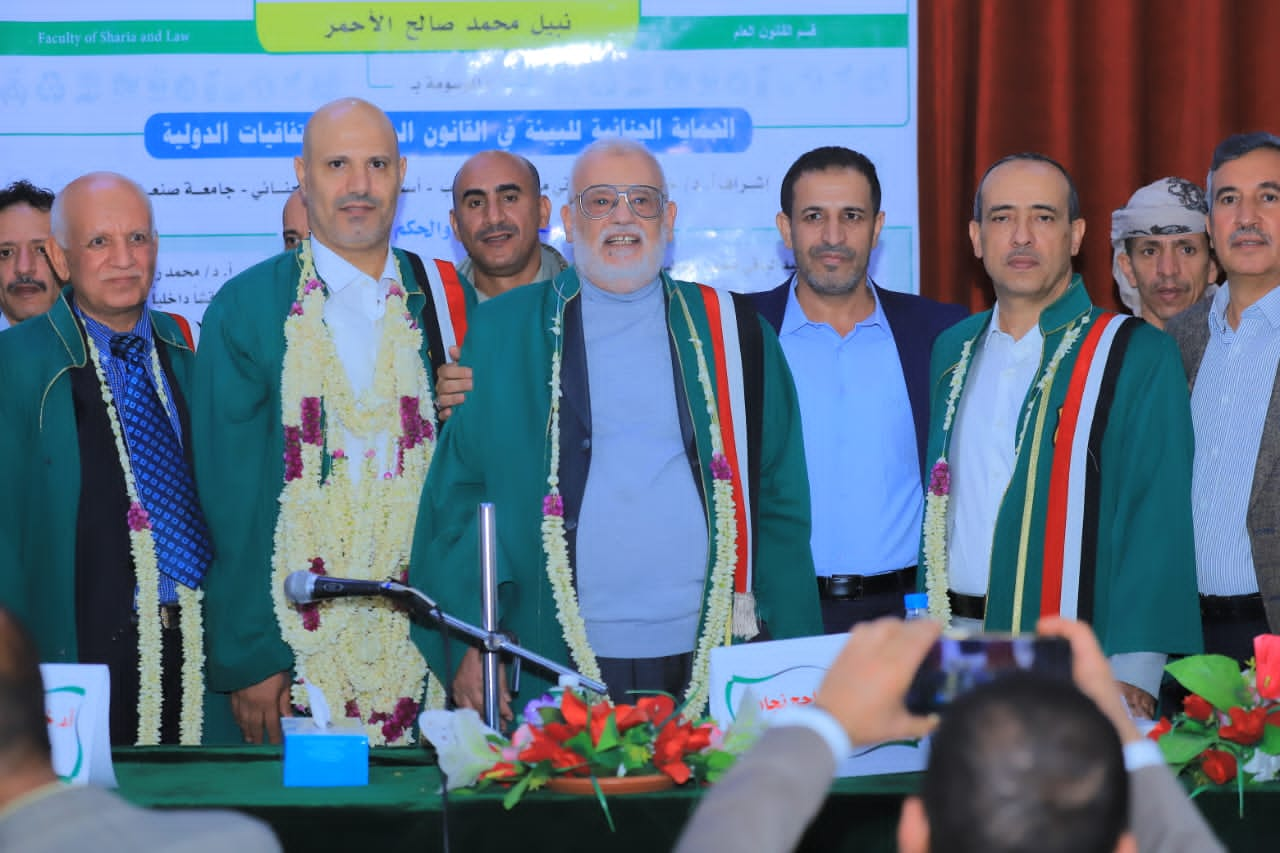
Researcher Nabil Mohammed Saleh Al-Ahmar was awarded a PhD degree in Public Law for his dissertation titled: Criminal Protection of the Environment under Yemeni Law and International Conventions, which was submitted to the Faculty of Sharia and Law–Sana’a University. The dissertation defense was held on Monday, October 26, 2026.
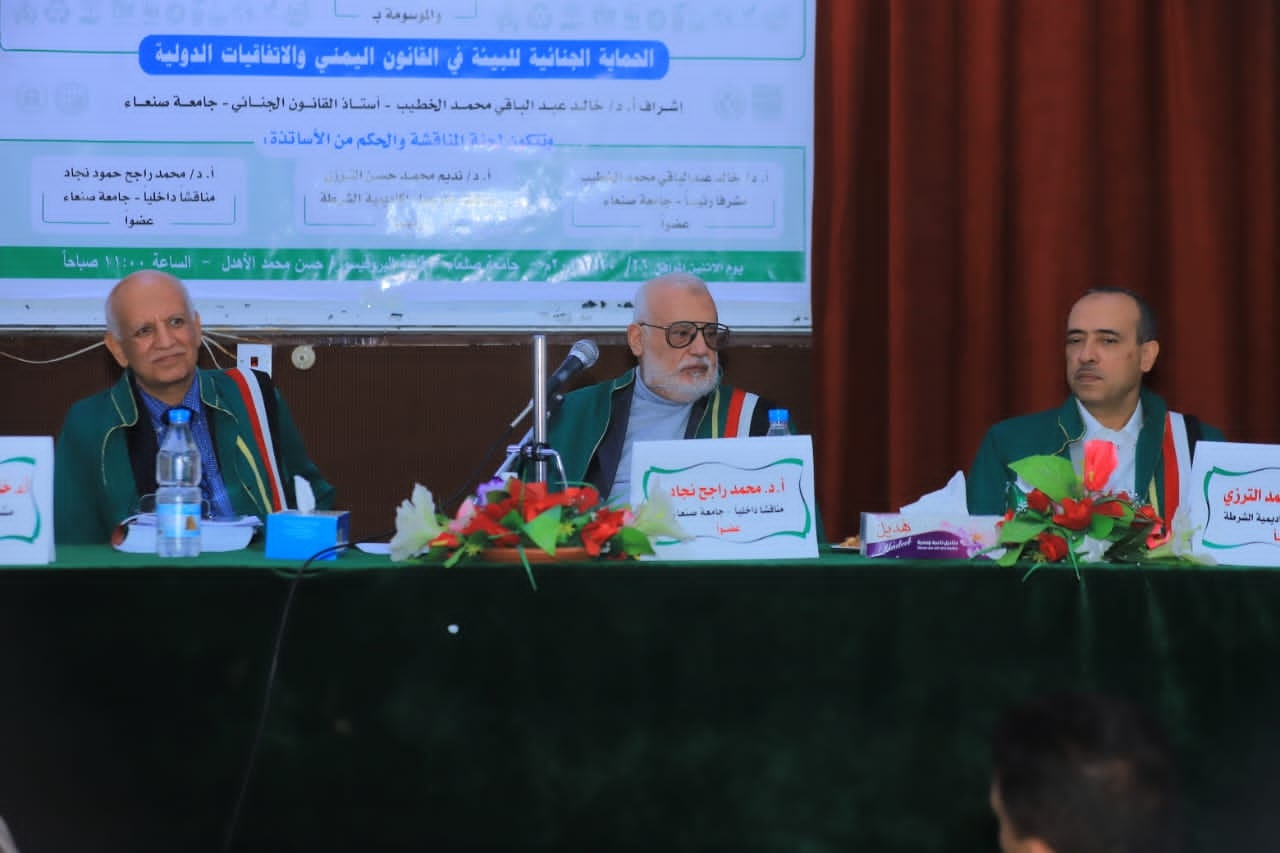
The PhD Viva-Voce Committee, which was formed based on a resolution issued by the Graduate Studies and Scientific Research Council, consisted of the following:
• Prof. Nadeem Mohammed Hasan Al-Tarzi – External Examiner and Committee Chair.
• Prof. Mohammed Rajeh Hamoud Najad – Internal Examiner and Committee Member.
• Prof. Khaled Abdulbaqi Mohammed Al-Khatib – Supervisor and Committee Member.
The dissertation aimed to:
1. Establish the conceptual and theoretical foundations of key concepts relating to the environment, environmental pollution, and environmental crime, and identify their characteristics and forms.
2. Explain the legal basis for the criminal protection of the environment and define the scope of the interests safeguarded through environmental criminalization.
3. Analyze the legal element of environmental pollution offenses and examine the compatibility of open-ended criminal provisions and flexible statutory provisions with the principle of legality in criminal law.
4. Examine the constituent elements of the actus reus of environmental crimes, including criminal conduct, consequences, and causation, and distinguish among offenses involving actual harm or risk, as well as instantaneous and continuing offenses.
5. Analyze the mental element of environmental pollution offenses, including the rules governing criminal intent and negligence, and examine whether certain environmental offenses may be established solely through the commission of the prohibited conduct.
6. Identify the persons who may incur criminal liability for environmental offenses and examine the liability of natural and legal persons, facility managers, and those responsible for oversight and supervision.
7. Examine defenses and grounds for excluding criminal liability in environmental cases and establish safeguards against their overly broad application.
8. Define the scope of international criminal responsibility for environmental crimes and examine the jurisdiction of international criminal courts and the penalties prescribed for perpetrators of serious environmental violations.
9. Analyze the principal and supplementary penalties, precautionary measures, and administrative and civil sanctions applicable to environmental pollution offenses, assessing their effectiveness and proportionality.
10. Identify shortcomings in Yemen’s legal framework and propose legislative and institutional measures to strengthen criminal protection of the environment.
The dissertation reached several key findings summarized as follows:
1. Environmental crime has distinctive technical and legal characteristics that set it apart from conventional offenses. It may involve actual harm or risk, be instantaneous or continuing, and be intentional or negligent. Its effects may also emerge after a delay and stem from multiple sources, complicating the establishment of causation and the determination of liability.
2. Although Yemeni law provides for various forms of criminal protection, the liability of legal persons, and certain preventive and compensatory measures, the study found that the legal framework continues to suffer from ambiguity in some provisions, a lack of clarity regarding the mental element, and inadequate penalties. Fines, in particular, are not always commensurate with the severity of environmental damage or the economic gains derived from violations.
3. Direct international criminal protection of the environment remains limited, particularly outside the context of armed conflicts.
Based on these findings, the dissertation put forward several recommendations, including:
1. Modernizing Yemeni environmental legislation by providing precise definitions of environmental crime, environmental harm, and environmental risk, and clearly specifying the mental element required for each offense.
2. Strengthening the provisions governing the criminal liability of legal persons and facility managers, and linking fines to the severity of the damage and the benefits gained from the offense.
3. Making the removal of pollution and environmental restoration mandatory measures accompanying criminal penalties.
4. Establishing specialized judicial and prosecutorial units, strengthening technical and oversight capacities, and enhancing international cooperation to combat transboundary environmental crimes.
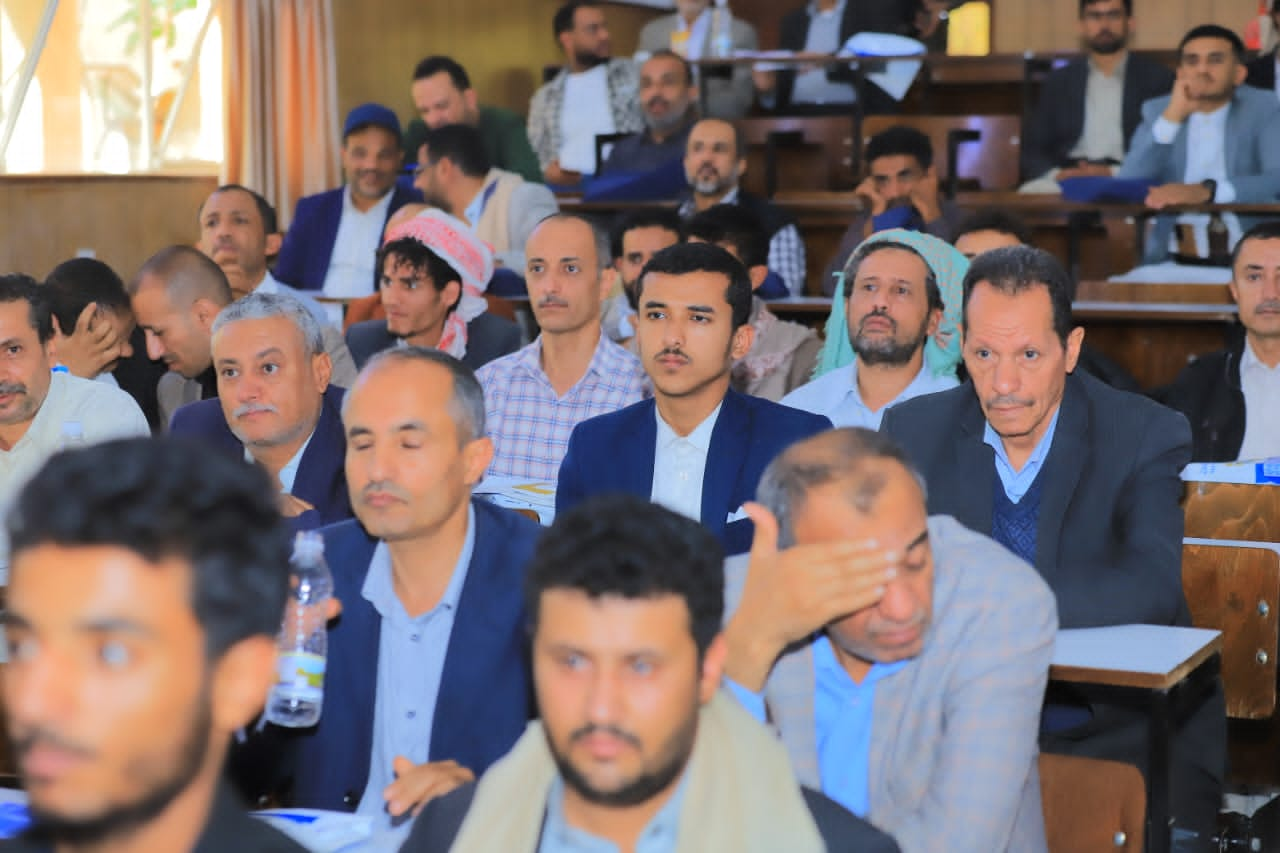
The dissertation defense was attended by a number of academics, graduate students, researchers, as well as the researcher's colleagues and family members.
.
https://youtube.com/shorts/uoynMGbc5YY?si=fqpDbfLx9y1AlLt_