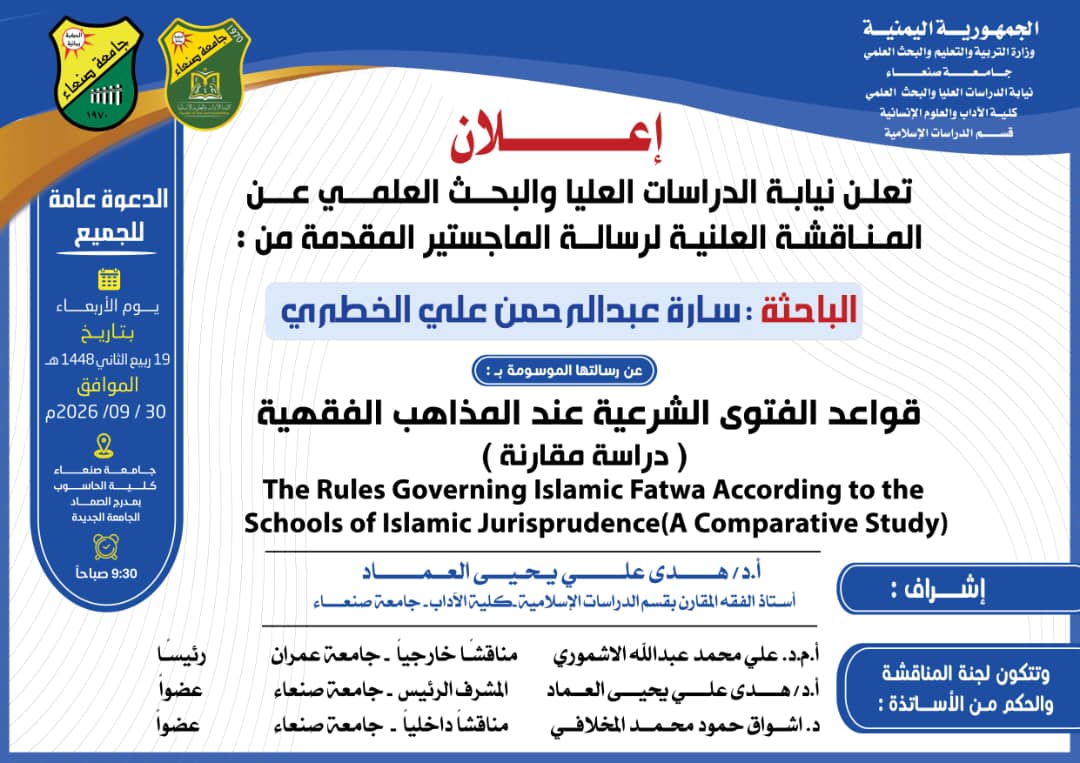
Researcher Tawbah Hazzaa Mohammed Naji Dahmash was awarded a Master’s Degree in Islamic Jurisprudence and Its Principles with a grade of excellent and an average of (95%) for her thesis titled: Jurisprudential Reasoning in Al-Taj Al-Maddhhab li Ahkam Al-Madhhab by the Scholar Al-Ansi, which was submitted to the Department of Islamic Studies, Faculty of Arts and Humanities– Sana’a University. The MA defense was held on Tuesday, September 15, 2026.
The MA Viva-voce Committee, which was formed based on a resolution issued by the Graduate Studies and Scientific Research Council, consisted of the following:
- Prof. Mohammed Abdulwahid Mohammed Al-Shuja’a – Sana’a University – Internal Examiner and Committee Chair.
- Dr. Saeed Ali Mohammed Al-Himyari– Sana’a University – Main Supervisor and Committee Member.
- Prof. Ali Ahmed Yahya Al-Qa’idi – Amran University – External Examiner and Committee Member.
The study aimed to provide a brief introduction to the scholar Al-‘Ansi and his book Al-Taj Al-Maddhhab li Ahkam Al-Madhhab, highlight the jurisprudential reasoning presented across different areas of Islamic jurisprudence, and clarify the meaning, origins, and stages of jurisprudential reasoning. It also sought to introduce the underlying legal rationales (‘ilal) of Islamic rulings, thereby drawing the attention and interest of researchers and scholars and encouraging further research, analysis, and scholarly writing, whether through studying the reasoning of Al-‘Ansi or that of other scholars. In addition, the study traced Al-‘Ansi’s reasoning for Islamic rulings and examined the extent to which it agrees or differs with the reasoning advanced by the majority of scholars.
The study reached several findings, most notably that Al-‘Ansi devoted considerable attention to presenting jurisprudential reasoning in his book Al-Taj Al-Maddhhab li Ahkam Al-Madhhab, Sharh Matn al-Azhar lil-A'immah al-Athehar. It also noted that scholars, both classical and contemporary, have given considerable attention to the issue of providing rationales for Islamic rulings.
The study demonstrated that Islamic Sharia is characterized by flexibility and applicability to all times and places, and that the rulings prescribed for people are intended to serve their interests and prevent harm.
The study also examined and critically analyzed 35 jurisprudential issues occurring in different parts of the book in which Al-‘Ansi’s reasoning was particularly evident. In some cases, he agreed with earlier scholars, while in others he differed from them. In developing his reasoning, he relied on transmitted and rational evidence, the soundness of the evidence, the apparent meanings of textual sources, and the objectives of Islamic Sharia. Qur’anic and Prophetic texts also had a significant bearing on his jurisprudential reasoning.
In light of these findings, the study recommended that researchers and editors give attention to completing the project of studying jurisprudential reasoning in the works of Al-‘Ansi, which the researcher initiated by tracing his jurisprudential rationales throughout Al-Taj Al-Maddhhab li Ahkam Al-Madhhab. His jurisprudential reasoning could provide a subject for a number of academic theses and dissertations.
It also recommended greater attention to the scholarly heritage of Yemeni scholars in general and the eminent jurist Al-‘Ansi in particular. In addition, it called for incorporating academic courses in the departments of Sharia and Islamic sciences at universities and institutes devoted to scholarly and jurisprudential reasoning, and for highlighting the merits of Islamic Sharia, particularly its flexibility and its rationale-based approach to legal rulings, through academic research and theses.
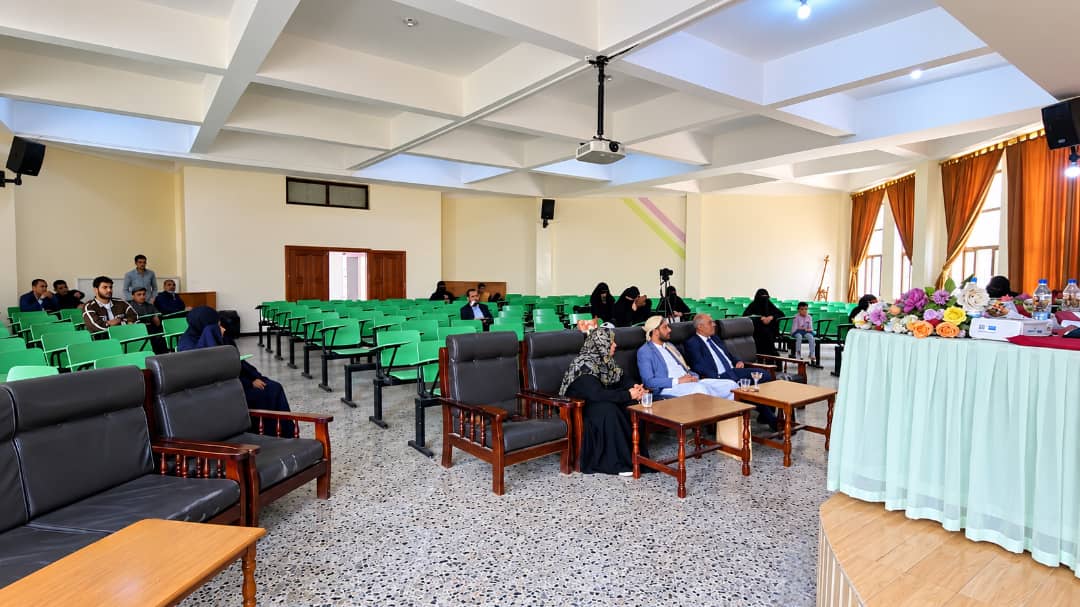
The thesis defense was attended by faculty members, researchers, students, and interested participants as well as the researcher's colleagues and family members.